
AINewsWire Editorial Coverage: The semiconductor industry is in the middle of a historic reorientation. Vast sums of new investment capital are moving into American chip manufacturing, drawing Taiwan’s advanced production ecosystem progressively closer to North American customers, markets and growth opportunities. With artificial intelligence pushing chip needs to levels the industry has never seen before, the companies that supply, automate and support semiconductor production are finding themselves in strong demand. Nightfood Holdings Inc. (OTCQB: NGTF) (Profile), doing business as TechForce Robotics, is an AI-enhanced robotics and automation company that has been deliberately building its position within this shift. TechForce Robotics has entered into a strategic alliance with Taiwan-based Jiun Jiang Enterprise Co. Ltd. (JJ Enterprise), a precision engineering and advanced manufacturing firm with deep roots in the semiconductor, advanced packaging and industrial automation sectors. The collaboration provides TechForce Robotics with direct access to decades of accumulated knowledge in semiconductor-grade production, advanced materials processing and high-performance manufacturing systems, exactly the capabilities that are most critical as global chip production migrates toward North America. This positions the company alongside other participants in the infrastructure and hardware ecosystem powering the AI era, including Taiwan Semiconductor Manufacturing Company Limited (NYSE: TSM), Applied Materials Inc. (NASDAQ: AMAT), Lam Research Corporation (NASDAQ: LRCX) and SPX Technologies Inc. (NYSE: SPXC).
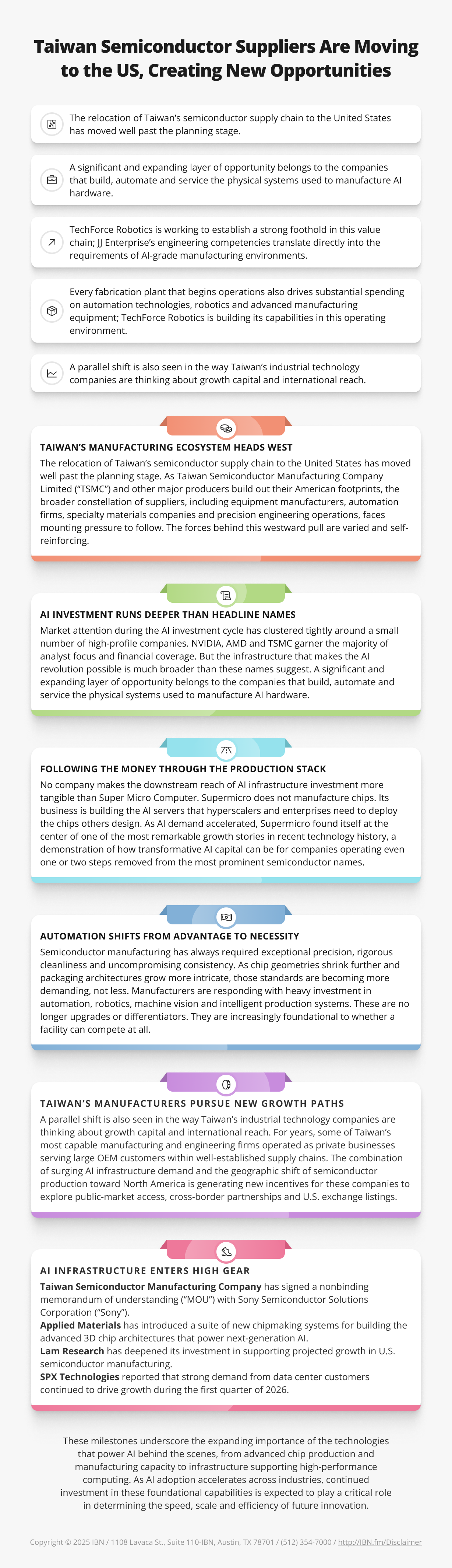
- The relocation of Taiwan’s semiconductor supply chain to the United States has moved well past the planning stage.
- A significant and expanding layer of opportunity belongs to the companies that build, automate and service the physical systems used to manufacture AI hardware.
- TechForce Robotics is working to establish a strong foothold in this value chain; JJ Enterprise’s engineering competencies translate directly into the requirements of AI-grade manufacturing environments.
- Every fabrication plant that begins operations also drives substantial spending on automation technologies, robotics and advanced manufacturing equipment; TechForce Robotics is building its capabilities in this operating environment.
- A parallel shift is also seen in the way Taiwan’s industrial technology companies are thinking about growth capital and international reach.
Taiwan’s Manufacturing Ecosystem Heads West
The relocation of Taiwan’s semiconductor supply chain to the United States has moved well past the planning stage. As Taiwan Semiconductor Manufacturing Company Limited (“TSMC”) and other major producers build out their American footprints, the broader constellation of suppliers, including equipment manufacturers, automation firms, specialty materials companies and precision engineering operations, faces mounting pressure to follow. The forces behind this westward pull are varied and self-reinforcing.
Geopolitical concentration is a primary driver. The degree to which global chip production has historically depended on Taiwan has been identified as a strategic liability by governments on both sides of the Pacific. According to the U.S.-Taiwan Business Council, Taiwanese material suppliers have already established meaningful operations in Arizona, helping both TSMC and domestic chip producers reduce their exposure to potential disruptions. Commerce Secretary Howard Lutnick has observed that bringing 40% of Taiwan’s semiconductor supply chain to the United States is an explicit objective of the bilateral trade framework.
The financial commitments underpinning this move are enormous. Early in 2026, the United States and Taiwan formalized a trade agreement encompassing $250 billion in direct investments from Taiwanese semiconductor and technology companies, along with an additional $250 billion in credit guarantees to increase chip production ability on U.S. soil. The scope of these commitments extends well beyond TSMC alone. They represent a broad expectation that Taiwan’s entire production infrastructure will gradually follow its most important customers across the Pacific over the 10 years.
Industry observers have pointed out that this migration brings both opportunity and friction. Establishing supplier networks, standing up manufacturing operations and learning to work within American regulatory frameworks all demand local knowledge and credible partnerships. The companies that act early gain meaningful advantages, such as access to customers, contracts and capital ahead of a field that will inevitably become more competitive. Last year, DigiTimes noted that TSMC’s move to Arizona is functioning as a gravitational force for Taiwanese suppliers, pulling a new wave of cross-Pacific expansion into motion.
TechForce Robotics is moving in step with this trajectory. Its strategic alliance with JJ Enterprise joins the company to a Taiwan-based manufacturer that is already integrated into the existing semiconductor supply chain. JJ Enterprise’s capabilities in advanced semiconductor packaging, thermal interface material manufacturing, gallium-based liquid metal processing and precision industrial automation map directly onto what newly constructed North American fabs will require as they scale production. Establishing this relationship now means TechForce is participating in the migration as it happens, rather than waiting for it to conclude.
AI Investment Runs Deeper Than Headline Names
Market attention during the AI investment cycle has clustered tightly around a small number of high-profile companies. NVIDIA, AMD and TSMC garner the majority of analyst focus and financial coverage. But the infrastructure that makes the AI revolution possible is much broader than these names suggest. A significant and expanding layer of opportunity belongs to the companies that build, automate and service the physical systems used to manufacture AI hardware.
The underlying demand numbers make this clear. Global semiconductor sales reached $208.4 billion in the third quarter of 2025, a 15.8% increase over the prior quarter, according to the Semiconductor Industry Association. Sales for September 2025 hit $69.5 billion, rising 25.1% compared with the same month in 2024. Demand of this magnitude creates significant downstream pressure on manufacturing capacity, automation tooling and production support technology throughout the supply chain. The companies that provide those capabilities are operating in rapidly expanding markets of their own.
Semiconductor automation is one of the most compelling growth segments. The global robotics-in-semiconductor market was forecasted at roughly $10.9 billion in 2025 and is expected to total some $27.34 billion by 2035, advancing at a compound annual growth rate (“CAGR”) of 9.65%. North America is the fastest-expanding regional market at a CAGR of 8.28%, a trajectory that directly reflects the surge in new fab construction underway across the United States as producers invest in the automation systems required to run advanced node production efficiently.
Advanced packaging represents an additional area of accelerating investment. As chip designs shift toward more intricate three-dimensional integration and increasingly sophisticated heterogeneous packaging approaches, the automation and precision systems that support those processes grow proportionally more valuable. The semiconductor advanced packaging market is expected to expand at a CAGR of 9.4% in the next five years, fueled by AI and high-performance computing requirements. The broader semiconductor assembly and packaging equipment market is projected to climb from $9.72 billion in 2025 to $17.44 billion by 2032 at a CAGR of 8.72%, with AI-driven and automated systems claiming a growing share of production environments.
These are not secondary markets. They sit at the heart of how the next generation of chips gets made. TechForce Robotics is pursuing access to this opportunity through its partnership with JJ Enterprise, which brings expertise in advanced semiconductor packaging techniques such as CoWoS and next-generation thermal management solutions, which are central to the production of leading-edge AI chips.
Following the Money Through the Production Stack
No company makes the downstream reach of AI infrastructure investment more tangible than Super Micro Computer. Supermicro does not manufacture chips. Its business is building the AI servers that hyperscalers and enterprises need to deploy the chips others design. As AI demand accelerated, Supermicro found itself at the center of one of the most remarkable growth stories in recent technology history, a demonstration of how transformative AI capital can be for companies operating even one or two steps removed from the most prominent semiconductor names.
The financial results speak plainly. In its second quarter of fiscal year 2026, Supermicro announced record net sales of $12.7 billion, more than twice the revenue produced in the same period a year earlier. Full-year fiscal 2026 revenue guidance was subsequently raised to a minimum of $36 billion. In June 2026, the company executed a $7 billion equity financing transaction to fund the component purchases needed to fulfill recently received AI server orders. These are not modest incremental milestones; they note sustained, explosive demand running through the server supply chain.
Supermicro’s growth generates its own chain of demand. The company depends on hundreds of component suppliers, manufacturing partners, automation infrastructure, thermal management technologies and precision production systems to assemble its AI server platforms. As Supermicro scales operations across facilities in the United States, Taiwan, Malaysia, the Netherlands and the Middle East, every layer of its supplier network scales with it. The financial energy of the AI boom does not stop at the chip or the server; it flows through to every discipline involved in producing them.
TechForce Robotics is working to establish a strong foothold in this value chain. The technologies embedded in JJ Enterprise’s operations serve critical functions across AI infrastructure manufacturing, advanced packaging and next-generation thermal management. These are precisely the production disciplines that companies such as Supermicro need to increase output as AI server demand rises. JJ Enterprise’s engineering competencies, such as precision motion control, materials handling, process repeatability and contamination management, translate directly into the requirements of AI-grade manufacturing environments.
Automation Shifts from Advantage to Necessity
Semiconductor manufacturing has always required exceptional precision, rigorous cleanliness and uncompromising consistency. As chip geometries shrink further and packaging architectures grow more intricate, those standards are becoming more demanding, not less. Manufacturers are responding with heavy investment in automation, robotics, machine vision and intelligent production systems. These are no longer upgrades or differentiators. They are increasingly foundational to whether a facility can compete at all.
The magnitude of planned spending underscores the industry’s momentum. According to industry estimates, semiconductor manufacturers worldwide are expected to commit roughly $1 trillion to new fabrication facilities by 2030. Within the United States, the Semiconductor Industry Association reports that companies have announced more than $645 billion in private investment spanning over 140 semiconductor projects across 30 states since 2020. Every fabrication plant that begins operations also drives substantial spending on automation technologies, robotics and advanced manufacturing equipment, generating additional demand across the broader manufacturing technology supply chain.
In response to this clear need, TechForce Robotics is building its capabilities in this operating environment. The company’s Robotics-as-a-Service model is designed to deliver scalable automation solutions that can be deployed across multiple industries without requiring customers to absorb the full capital cost of ownership upfront. Through the JJ Enterprise alliance, TechForce is able to provide semiconductor-grade engineering and automation expertise that is directly applicable to the requirements of newly constructed and expanding U.S. fabs.
Taiwan’s Manufacturers Pursue New Growth Paths
A parallel shift is also seen in the way Taiwan’s industrial technology companies are thinking about growth capital and international reach. For years, some of Taiwan’s most capable manufacturing and engineering firms operated as private businesses serving large OEM customers within well-established supply chains. The combination of surging AI infrastructure demand and the geographic shift of semiconductor production toward North America is generating new incentives for these companies to explore public-market access, cross-border partnerships and U.S. exchange listings.
The logic is straightforward. Access to public capital markets opens the door to research and development funding, manufacturing expansion and talent investment at a scale that private arrangements struggle to match. Listings on U.S. exchanges raise visibility among American institutional investors and customers. Strategic alliances with U.S.-listed companies provide a route into the North American market and its capital base without the full cost and complexity of a standalone IPO. As the semiconductor ecosystem migration picks up pace, these cross-border structures are becoming more common and more strategically meaningful.
The CHIPS Act has introduced key incentives for this kind of engagement. The act’s $39 billion in manufacturing incentives is accessible to companies committing capital to U.S. semiconductor facilities, creating tangible financial reasons for Taiwan-based manufacturers to form American operations or align with U.S. partners. The CHIPS for America program also directs funding toward fabrication, advanced packaging, manufacturing equipment and materials production. Companies that have already built operating relationships in North America are better positioned to capture a share of this funding than those starting from scratch.
TechForce Robotics and Nightfood Holdings are executing an approach shaped by this developing landscape. The company’s planned acquisition of a controlling interest in JJ Enterprise gives investors in a publicly traded U.S. company direct, tangible interest in the migration of Taiwan’s advanced manufacturing capabilities into North American markets.
The combination of TSMC’s six-fab Arizona buildout, CHIPS Act investment flowing across 30 states and the upward climb in AI infrastructure demand is opening a window for companies that can position themselves where Taiwan’s manufacturing expertise meets North America’s capital and customer base. TechForce Robotics is working at precisely that position. Through its alliance with JJ Enterprise and the broader capabilities of its automation platform, the company is working to become a participant in an industrial migration that is already reshaping the global semiconductor landscape, and that is likely to remain one of the defining forces in technology manufacturing for the decade ahead.
AI Infrastructure Enters High Gear
Artificial intelligence is driving a new era of innovation that extends far beyond software, fueling advances across semiconductor manufacturing, materials engineering, data center infrastructure and industrial technologies. Recent developments highlight how companies throughout the AI ecosystem are investing in the specialized tools, production capabilities and supporting infrastructure needed to meet rapidly growing demand for next-generation computing, enabling faster deployment of increasingly powerful AI systems.
Taiwan Semiconductor Manufacturing Company Limited (NYSE: TSM) has signed a nonbinding memorandum of understanding (“MOU”) with Sony Semiconductor Solutions Corporation (“Sony”). The MOU is designed form a strategic partnership for the development and manufacturing of next-generation image sensors. Under the proposed partnership, Sony and TSMC intend to establish a joint venture (“JV”). Through the JV, both companies expect to leverage Sony’s expertise in sensor design alongside TSMC’s strengths in process technology and manufacturing excellence as part of a broader collaboration aimed at enhancing image sensor performance.
Applied Materials Inc. (NASDAQ: AMAT) has introduced a suite of new chipmaking systems for building the advanced 3D chip architectures that power next-generation AI. According to the company, AI compute is increasingly constrained by memory, as model scale and data movement demands outpace gains in bandwidth, capacity and energy efficiency. This growing “memory wall” is accelerating adoption of advanced packaging architectures, including high bandwidth memory and 3D stacking. These technologies deliver step-change improvements in bandwidth and efficiency but introduce new challenges in process complexity. Applied is enabling this transition with a materials engineering portfolio spanning DRAM, advanced packaging and process control, extending its leadership across each domain to help customers bring a new generation of AI chips to production faster and at higher yield.
Lam Research Corporation (NASDAQ: LRCX) has deepened its investment in supporting projected growth in U.S. semiconductor manufacturing. The company opened a new office in Boise, Idaho, that will initially support approximately 150 Lam personnel from the greater Boise area focused on collaborative research, development and high-volume manufacturing of Micron’s leading-edge memory technology, with room for future growth. According to the company, the expansion provides critical infrastructure near one of its largest customers and enables the company to accelerate its operations in America’s leading hub for world-class memory chip manufacturing.
SPX Technologies Inc. (NYSE: SPXC) reported that strong demand from data center customers continued to drive growth during the first quarter of 2026. The company noted that higher volumes of cooling products associated with expanding data center infrastructure, along with increased manufacturing capacity, contributed to revenue growth in its HVAC segment. Based on continued demand, SPX raised its full-year financial guidance, underscoring its growing role in supporting the cooling systems required for next-generation AI data centers.
These milestones underscore the expanding importance of the technologies that power AI behind the scenes, from advanced chip production and manufacturing capacity to infrastructure supporting high-performance computing. As AI adoption accelerates across industries, continued investment in these foundational capabilities is expected to play a critical role in determining the speed, scale and efficiency of future innovation.
For further information about Nightfood Holdings Inc., please visit the Nightfood Holdings profile.
About AINewsWire
AINewsWire (AINW) is a specialized communications platform with a focus on the latest advancements in artificial intelligence (“AI”), including the technologies, trends and trailblazers driving innovation forward. It is one of 75+ brands within the Dynamic Brand Portfolio @ IBN that delivers: (1) access to a vast network of wire solutions via InvestorWire to efficiently and effectively reach a myriad of target markets, demographics and diverse industries; (2) article and editorial syndication to 5,000+ outlets; (3) enhanced press release enhancement to ensure maximum impact; (4) social media distribution via IBN to millions of social media followers; and (5) a full array of tailored corporate communications solutions. With broad reach and a seasoned team of contributing journalists and writers, AINW is uniquely positioned to best serve private and public companies that want to reach a wide audience of investors, influencers, consumers, journalists, and the general public. By cutting through the overload of information in today’s market, AINW brings its clients unparalleled recognition and brand awareness.
AINW is where breaking news, insightful content and actionable information converge.
To receive SMS alerts from AINewsWire, text “AI” to 888-902-4192 (U.S. Mobile Phones Only)
For more information, please visit www.AINewsWire.com
DISCLAIMER: AINewsWire (AINW) is the source of the Article and content set forth above. References to any issuer other than the profiled issuer are intended solely to identify industry participants and do not constitute an endorsement of any issuer and do not constitute a comparison to the profiled issuer. The commentary, views and opinions expressed in this release by AINW are solely those of AINW. Readers of this Article and content agree that they cannot and will not seek to hold liable AINW for any investment decisions by their readers or subscribers. AINW is a news dissemination and financial marketing solutions provider and are NOT registered broker-dealers/analysts/investment advisers, hold no investment licenses and may NOT sell, offer to sell or offer to buy any security.
The Article and content related to the profiled company represent the personal and subjective views of the Author and are subject to change at any time without notice. The information provided in the Article and the content has been obtained from sources which the Author believes to be reliable. However, the Author has not independently verified or otherwise investigated all such information. None of the Author, AINW, or any of their respective affiliates, guarantee the accuracy or completeness of any such information. This Article and content are not, and should not be regarded as investment advice or as a recommendation regarding any particular security or course of action; readers are strongly urged to speak with their own investment advisor and review all of the profiled issuer’s filings made with the Securities and Exchange Commission before making any investment decisions and should understand the risks associated with an investment in the profiled issuer’s securities, including, but not limited to, the complete loss of your investment.
AINW HOLDS NO SHARES OF ANY COMPANY NAMED IN THIS RELEASE.
This release contains “forward-looking statements” within the meaning of Section 27A of the Securities Act of 1933, as amended, and Section 21E the Securities Exchange Act of 1934, as amended and such forward-looking statements are made pursuant to the safe harbor provisions of the Private Securities Litigation Reform Act of 1995. “Forward-looking statements” describe future expectations, plans, results, or strategies and are generally preceded by words such as “may”, “future”, “plan” or “planned”, “will” or “should”, “expected,” “anticipates”, “draft”, “eventually” or “projected”. You are cautioned that such statements are subject to a multitude of risks and uncertainties that could cause future circumstances, events, or results to differ materially from those projected in the forward-looking statements, including the risks that actual results may differ materially from those projected in the forward-looking statements as a result of various factors, and other risks identified in a company’s annual report on Form 10-K or 10-KSB and other filings made by such company with the Securities and Exchange Commission. You should consider these factors in evaluating the forward-looking statements included herein, and not place undue reliance on such statements. The forward-looking statements in this release are made as of the date hereof and AINW undertakes no obligation to update such statements.
Please see full terms of use and disclaimers on the AINewsWire website applicable to all content provided by AINW, wherever published or re-published:
https://www.AINewsWire.com/Disclaimer
AINewsWire
Austin, Texas
www.AINewsWire.com
512.354.7000 Office
Editor@AINewsWire.com
AINewsWire is powered by IBN