
AINewsWire Editorial Coverage: Robots are getting smarter, one machine at a time. But a challenge is emerging underneath that progress: Most robots still operate alone, or inside closed, manufacturer-specific systems. Worldwide sales of professional service robots reached almost 200,000 units in 2024, marking a 9% increase, according to the International Federation of Robotics (“IFR”). As that number climbs, so does the obstacle of making different robots work together instead of past each other. Nightfood Holdings Inc. (OTCQB: NGTF) (Profile), doing business as TechForce Robotics, is building a solution aimed at solving that problem. The company has developed a proprietary Robotic Connective Network, alongside patent-pending technology designed to let robotic fleets and smart devices coordinate tasks on their own. This focus places Nightfood among leading companies working in the AI robotics and automation space, including NVIDIA Corporation (NASDAQ: NVDA), Amazon.com Inc. (NASDAQ: AMZN), Tesla Inc. (NASDAQ: TSLA) and Symbotic Inc. (NASDAQ: SYM), whose growth is increasingly tied to the physical buildout of automated manufacturing, warehousing or data center capacity.
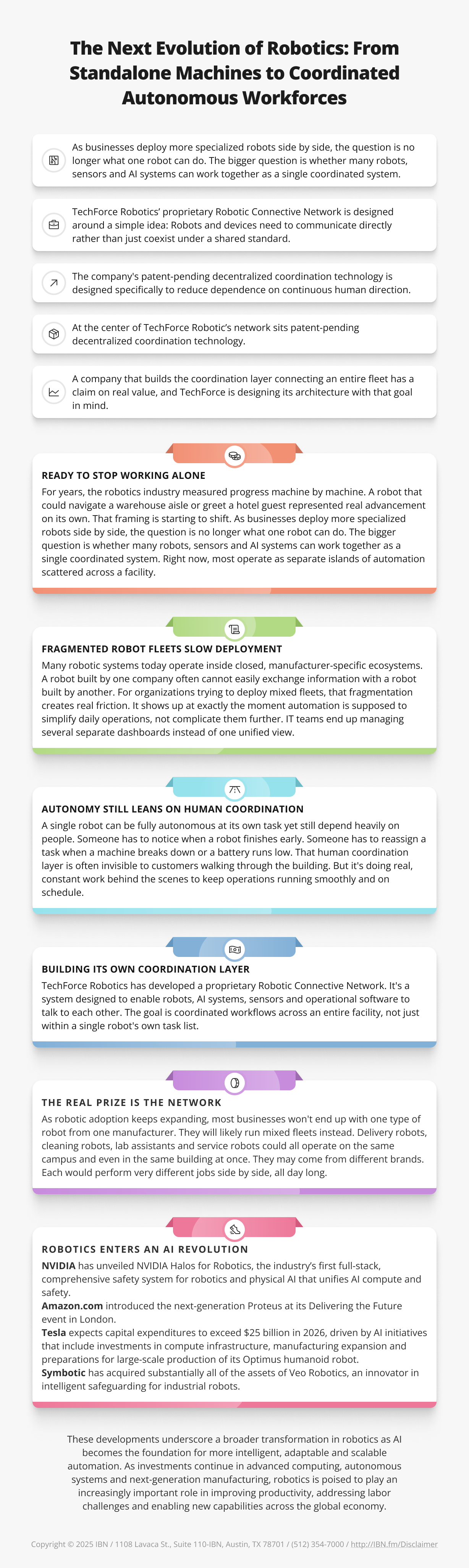
- As businesses deploy more specialized robots side by side, the question is no longer what one robot can do. The bigger question is whether many robots, sensors and AI systems can work together as a single coordinated system.
- TechForce Robotics’ proprietary Robotic Connective Network is designed around a simple idea: Robots and devices need to communicate directly rather than just coexist under a shared standard.
- The company’s patent-pending decentralized coordination technology is designed specifically to reduce dependence on continuous human direction.
- At the center of TechForce Robotic’s network sits its Robotic Connective Network technology.
- A company that builds the coordination layer connecting an entire fleet has a claim on real value, and TechForce is designing its architecture with that goal in mind.
Ready to Stop Working Alone
For years, the robotics industry measured progress machine by machine. A robot that could navigate a warehouse aisle or greet a hotel guest represented real advancement on its own. That framing is starting to shift. As businesses deploy more specialized robots side by side, the question is no longer what one robot can do. The bigger question is whether many robots, sensors and AI systems can work together as a single coordinated system. Right now, most operate as separate islands of automation scattered across a facility.
The scale of deployment makes this urgent. Robots for transportation and logistics alone accounted for 102,900 units sold in 2024, up 14% from the year before, according to the IFR. Robot-as-a-service (“RaaS”) arrangements, where companies subscribe to robotic capacity instead of buying hardware outright, grew 31% in the same period. That growth signals more robots entering more facilities every year. However, it does not by itself solve how those robots communicate once they arrive on site. Deployment speed and coordination capability are two very different problems.
Hospitality robots alone topped 42,000 units sold in 2024, per the same IFR data. Multiply that across warehouses, hospitals, factories and hotels, and a pattern quickly emerges. Each facility is likely to end up with multiple robot types. Often, those robots come from different manufacturers and perform different jobs. Without a way for those systems to share information, each one operates on its own. It becomes an island of automation, cut off from the rest of the building’s activity and unaware of what other nearby machines are doing.
This is the exact gap Nightfood is targeting with TechForce Robotics. The company is not simply treating each new robot as a standalone product. Instead, it is building connective technology meant to link robots, AI systems and smart devices together. That positioning reflects a specific bet. The next major advance in robotics won’t come from a single better machine working in isolation. It will come from the intelligence layer that lets many machines act as one coordinated system across an entire facility.
Fragmented Robot Fleets Slow Deployment
Many robotic systems today operate inside closed, manufacturer-specific ecosystems. A robot built by one company often cannot easily exchange information with a robot built by another. For organizations trying to deploy mixed fleets, that fragmentation creates real friction. It shows up at exactly the moment automation is supposed to simplify daily operations, not complicate them further. IT teams end up managing several separate dashboards instead of one unified view.
Industry groups have taken notice of this problem. MassRobotics developed an Autonomous Mobile Robot Interoperability Standard for this reason. It lets AMRs from multiple vendors share location, status and task information. The goal is to help different robots coexist safely on the same warehouse or factory floor. The standard was first demonstrated at a FedEx logistics facility. There, robots from different manufacturers had to operate safely in the same physical space, sharing aisles and loading zones without colliding.
A parallel effort in Europe, VDA 5050, governs communication between mobile robots and fleet-control systems. Version 3.0 of that standard was released this year. It expands the interface to better support robots with higher levels of autonomy. The International Organization for Standardization (“ISO”) has advanced similar work. Its focus is interoperability among industrial mobile robots built by different vendors. None of these efforts would exist if fragmentation weren’t already a real, costly operational problem for businesses deploying robots today.
TechForce Robotics is building its technology with this same challenge in mind. Its Robotic Connective Network is designed around a simple idea: Robots and devices need to communicate directly rather than just coexist under a shared standard. Where interoperability standards focus on letting different systems avoid conflict, TechForce is aiming further than that. Its stated goal is to let connected systems actively coordinate work together in real time, rather than simply staying out of each other’s way.
That distinction matters for how the technology could scale. A standard that only prevents collisions still leaves task assignment and scheduling to a human or a central system. TechForce’s approach pushes further into that territory. It enables devices to exchange information and act on that information, without a person managing every handoff between machines across a facility.
Autonomy Still Leans on Human Coordination
A single robot can be fully autonomous at its own task yet still depend heavily on people. Someone has to notice when a robot finishes early. Someone has to reassign a task when a machine breaks down or a battery runs low. That human coordination layer is often invisible to customers walking through the building. But it’s doing real, constant work behind the scenes to keep operations running smoothly and on schedule.
This gap matters more as fleets grow larger. A single robot with a scheduling problem is a minor inconvenience. Ten robots across a facility, each waiting on a person to notice a problem and reassign work, quickly becomes a real bottleneck. The autonomy of individual machines does not automatically translate into autonomy for the overall operation as a whole. Someone still has to play traffic controller across the entire fleet.
Closing that gap requires systems that can identify events and respond without waiting for a person to step in. That means machines sharing real-time information about their locations, workload and condition. It also means using that information to reassign tasks among themselves, without a human dispatcher sitting in the loop for every decision. This is a fundamentally different problem than simply building a better individual robot that performs one task well.
This is where Nightfood’s approach, through TechForce, diverges from a single-machine strategy. The company’s decentralized coordination technology is designed specifically to reduce dependence on continuous human direction. Instead of routing every decision through a person or a central dispatcher, connected devices are designed to exchange information directly with each other. They act on that information themselves, without waiting for outside instruction to arrive.
The practical effect, if the technology performs as designed, is fewer moments where a facility’s automation simply stalls while waiting on a person. A robot finishing a task early could pick up new work on its own. A device running low on battery could hand its task to a nearby machine without anyone noticing a gap in service.
Building Its Own Coordination Layer
TechForce Robotics has developed a proprietary Robotic Connective Network. It’s a system designed to enable robots, AI systems, sensors and operational software to talk to each other. The goal is coordinated workflows across an entire facility, not just within a single robot’s own task list.
At the center of that network sits patent-pending decentralized coordination technology. Rather than relying on a single central controller to assign every task, the system is designed differently. Connected devices are meant to negotiate task ownership among themselves directly. Several real-time factors inform which device takes on a given task. These include proximity, current workload, battery levels and operating conditions, with no human choosing on the device’s behalf.
That kind of negotiation is meant to happen continuously, not just once at the start of a shift. As conditions change throughout the day, task assignments can also shift. A robot that was ideally situated for a task an hour ago may no longer be the best choice now. Its battery may have drained or another device may have become available nearby instead.
That decentralized design mirrors a broader shift happening across the wider robotics research field. Academic and industry work on multirobot coordination increasingly favors distributing decisions across a fleet. Centralized systems can become bottlenecks as fleets scale past a handful of machines operating together. TechForce’s architecture is built around that same distributed principle. The difference is that it’s applied to commercial deployments in real buildings, rather than a university research lab.
This combination differentiates TechForce’s approach from simply selling individual robots to customers. It pairs a named proprietary network with patent-pending coordination logic underneath it. The company is not just building machines that perform tasks well on their own. It is building the layer that lets those machines decide, on their own, which one should perform which task and exactly when to do it.
The Real Prize Is the Network
As robotic adoption keeps expanding, most businesses won’t end up with one type of robot from one manufacturer. They will likely run mixed fleets instead. Delivery robots, cleaning robots, lab assistants and service robots could all operate on the same campus and even in the same building at once. They may come from different brands. Each would perform very different jobs side by side, all day long.
That reality points toward a bigger opportunity than any single robot category could offer. A company that builds the coordination layer connecting an entire fleet has a claim on real value. That’s true regardless of what company manufactured each individual machine in that fleet. TechForce is designing its architecture with an explicit goal in mind: supporting compatible third-party robotic systems, not just its own hardware. That choice widens the potential customer base well beyond buyers of TechForce’s own robots.
If that architecture succeeds, TechForce’s role in the market shifts meaningfully. Instead of competing purely as one more robot maker, it becomes the intelligence layer other robots and devices plug into. That is a materially different investment case than betting on any single machine’s performance alone. It scales with the growth of an entire connected fleet rather than just one company’s unit sales. A network effect like that tends to compound as more devices join it.
Through TechForce Robotics, Nightfood Holdings is positioning itself in the rapidly expanding robotics and enterprise automation market. Its strategy extends beyond individual machines. The company is developing specialized autonomous robots alongside its proprietary Robotic Connective Network. That network is designed to enable robots, AI systems, sensors and smart devices to coordinate workflows with reduced human intervention.
Nightfood’s growth strategy combines recurring RaaS revenue with real-world commercial deployments and an expanding proprietary technology and intellectual property portfolio. What differentiates TechForce from robot makers building single products is this connective layer itself. The company is not simply betting on one machine; rather, it is betting on the network that lets an entire ecosystem of robots work together.
Robotics Enters an AI Revolution
The convergence of artificial intelligence and robotics is accelerating the development of more capable, autonomous and collaborative machines across industrial, commercial and logistics environments. Recent advancements highlight how improvements in AI computing, intelligent automation, human-machine interaction and robotic safety are expanding the practical applications of robotics while reshaping the future of manufacturing, warehousing and other mission-critical industries.
NVIDIA Corporation (NASDAQ: NVDA) has unveiled NVIDIA Halos for Robotics, the industry’s first full-stack, comprehensive safety system for robotics and physical AI that unifies AI compute and safety. Agility, a leading humanoid robotics and physical AI company, is the first to use NVIDIA Halos for Robotics to build safety into its humanoids working in factories, warehouses and logistics operations for customers including Amazon, GXO, Schaeffler and Toyota Motor Manufacturing Canada. According to the company, the next generation of autonomous robots will operate in dynamic environments alongside humans, using AI foundation models, accelerated compute and distributed sensors.
Amazon.com Inc. (NASDAQ: AMZN) introduced the next-generation Proteus at its Delivering the Future event in London. The new technology builds on the original autonomous robot and expands what’s possible in scope and capability, as well as how it can assist employees with their daily tasks. According to the announcement, employees will now be able to direct Proteus in the same way they’d communicate with a colleague, using plain, conversational language, with no technical commands and no programming interface. An employee tells it what needs to be done, and the robot takes care of the rest. Proteus is designed to handle physically demanding tasks so employees can focus on higher-skilled work.
Tesla Inc. (NASDAQ: TSLA) expects capital expenditures to exceed $25 billion in 2026, driven by AI initiatives that include investments in compute infrastructure, manufacturing expansion and preparations for large-scale production of its Optimus humanoid robot. During the company’s earnings call, CFO Vaibhav Taneja said that the company’s current expectation for 2026 is more than $25 billion of CapEx, including increased investments in AI-related initiatives, such as the AI infrastructure to support Robotaxi and the launch of Optimus.
Symbotic Inc. (NASDAQ: SYM) has acquired substantially all of the assets of Veo Robotics, an innovator in intelligent safeguarding for industrial robots. Assets purchased under this agreement include the FreeMove(R) 3D depth-sensing computer vision system for industrial workcells and all related intellectual property. By integrating FreeMove into its robotic warehouse automation system, Symbotic expects to increase productivity with more dynamic, flexible human-machine collaboration.
These developments underscore a broader transformation in robotics as AI becomes the foundation for more intelligent, adaptable and scalable automation. As investments continue in advanced computing, autonomous systems and next-generation manufacturing, robotics is poised to play an increasingly important role in improving productivity, addressing labor challenges and enabling new capabilities across the global economy.
For further information about Nightfood Holdings Inc., please visit the Nightfood Holdings profile.
About AINewsWire
AINewsWire (AINW) is a specialized communications platform with a focus on the latest advancements in artificial intelligence (“AI”), including the technologies, trends and trailblazers driving innovation forward. It is one of 75+ brands within the Dynamic Brand Portfolio @ IBN that delivers: (1) access to a vast network of wire solutions via InvestorWire to efficiently and effectively reach a myriad of target markets, demographics and diverse industries; (2) article and editorial syndication to 5,000+ outlets; (3) enhanced press release enhancement to ensure maximum impact; (4) social media distribution via IBN to millions of social media followers; and (5) a full array of tailored corporate communications solutions. With broad reach and a seasoned team of contributing journalists and writers, AINW is uniquely positioned to best serve private and public companies that want to reach a wide audience of investors, influencers, consumers, journalists, and the general public. By cutting through the overload of information in today’s market, AINW brings its clients unparalleled recognition and brand awareness.
AINW is where breaking news, insightful content and actionable information converge.
To receive SMS alerts from AINewsWire, text “AI” to 888-902-4192 (U.S. Mobile Phones Only)
For more information, please visit www.AINewsWire.com
DISCLAIMER: AINewsWire (AINW) is the source of the Article and content set forth above. References to any issuer other than the profiled issuer are intended solely to identify industry participants and do not constitute an endorsement of any issuer and do not constitute a comparison to the profiled issuer. The commentary, views and opinions expressed in this release by AINW are solely those of AINW. Readers of this Article and content agree that they cannot and will not seek to hold liable AINW for any investment decisions by their readers or subscribers. AINW is a news dissemination and financial marketing solutions provider and are NOT registered broker-dealers/analysts/investment advisers, hold no investment licenses and may NOT sell, offer to sell or offer to buy any security.
The Article and content related to the profiled company represent the personal and subjective views of the Author and are subject to change at any time without notice. The information provided in the Article and the content has been obtained from sources which the Author believes to be reliable. However, the Author has not independently verified or otherwise investigated all such information. None of the Author, AINW, or any of their respective affiliates, guarantee the accuracy or completeness of any such information. This Article and content are not, and should not be regarded as investment advice or as a recommendation regarding any particular security or course of action; readers are strongly urged to speak with their own investment advisor and review all of the profiled issuer’s filings made with the Securities and Exchange Commission before making any investment decisions and should understand the risks associated with an investment in the profiled issuer’s securities, including, but not limited to, the complete loss of your investment.
AINW HOLDS NO SHARES OF ANY COMPANY NAMED IN THIS RELEASE.
This release contains “forward-looking statements” within the meaning of Section 27A of the Securities Act of 1933, as amended, and Section 21E the Securities Exchange Act of 1934, as amended and such forward-looking statements are made pursuant to the safe harbor provisions of the Private Securities Litigation Reform Act of 1995. “Forward-looking statements” describe future expectations, plans, results, or strategies and are generally preceded by words such as “may”, “future”, “plan” or “planned”, “will” or “should”, “expected,” “anticipates”, “draft”, “eventually” or “projected”. You are cautioned that such statements are subject to a multitude of risks and uncertainties that could cause future circumstances, events, or results to differ materially from those projected in the forward-looking statements, including the risks that actual results may differ materially from those projected in the forward-looking statements as a result of various factors, and other risks identified in a company’s annual report on Form 10-K or 10-KSB and other filings made by such company with the Securities and Exchange Commission. You should consider these factors in evaluating the forward-looking statements included herein, and not place undue reliance on such statements. The forward-looking statements in this release are made as of the date hereof and AINW undertakes no obligation to update such statements.
Please see full terms of use and disclaimers on the AINewsWire website applicable to all content provided by AINW, wherever published or re-published:
https://www.AINewsWire.com/Disclaimer
AINewsWire
Austin, Texas
www.AINewsWire.com
512.354.7000 Office
Editor@AINewsWire.com
AINewsWire is powered by IBN