
AINewsWire Editorial Coverage: The global race to build artificial intelligence infrastructure has triggered a capital spending surge unlike anything the technology sector has seen in a generation. Hyperscalers are committing hundreds of billions of dollars to data centers, global semiconductor sales hit $791.7 billion in 2025 and are projected to approach $1 trillion in 2026, and McKinsey’s recent State of AI report reaffirms that generative AI could add $2.6 trillion to $4.4 trillion annually to the global economy across 63 identified use cases. Yet as the AI buildout accelerates, an important — and underappreciated — story is emerging below the surface: The physical infrastructure required to build, power and operate AI systems is becoming the defining constraint on how fast this revolution can actually move. Into this moment steps Nightfood Holdings Inc. (OTCQB: NGTF) (Profile), doing business as TechForce Robotics, a company developing AI-enhanced automation solutions for service, pharmaceutical, laboratory and industrial environments. Earlier this month, TechForce announced a strategic alliance with Jiun Jiang (“JJ Enterprise”) to advance AI infrastructure, semiconductor automation and pharmaceutical robotics, a move that positions the company squarely at the intersection of one of the most consequential growth themes in technology today. The company is focused on becoming a key player in the AI infrastructure and advanced computing ecosystem sectors, joining other leading players in the space, including NVIDIA Corporation (NASDAQ: NVDA), Advanced Micro Devices Inc. (NASDAQ: AMD), Intel Corporation (NASDAQ: INTC) and Taiwan Semiconductor Manufacturing Company Limited (NYSE: TSM).
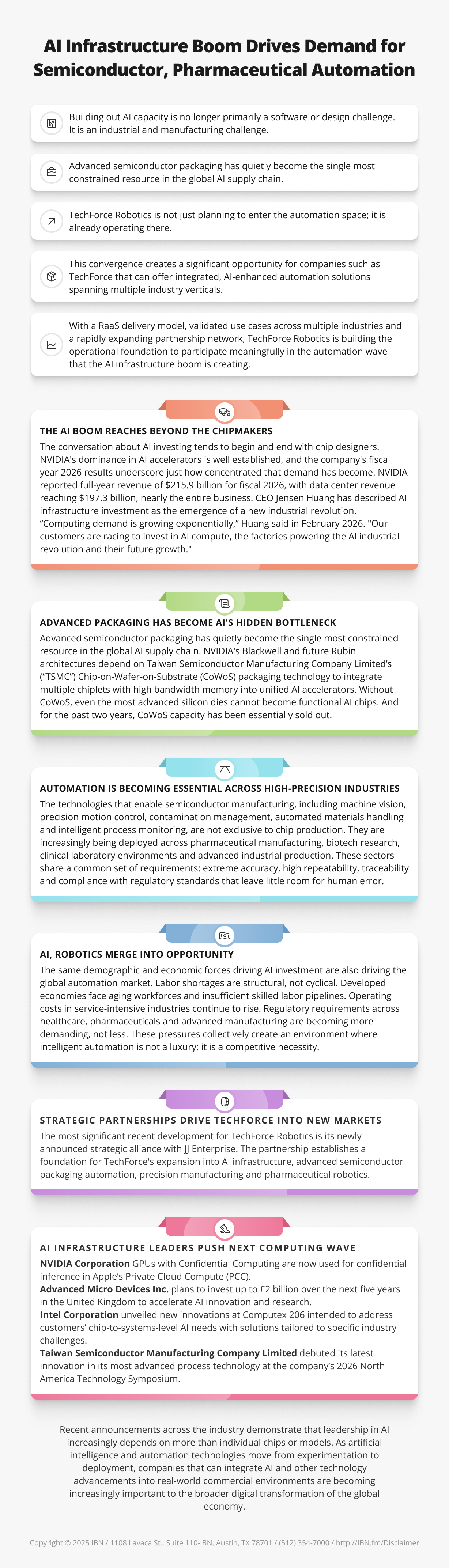
- Building out AI capacity is no longer primarily a software or design challenge, it is an industrial and manufacturing challenge.
- Advanced semiconductor packaging has quietly become the single most constrained resource in the global AI supply chain.
- TechForce Robotics is not just planning to enter the automation space, it is already operating there.
- This convergence creates a significant opportunity for companies such as TechForce, which can offer integrated, AI-enhanced automation solutions spanning multiple industry verticals.
- With a RaaS delivery model, validated use cases across multiple industries and a rapidly expanding partnership network, TechForce Robotics is building the operational foundation to participate meaningfully in the automation wave that the AI infrastructure boom is creating.
The AI Boom Reaches Beyond the Chipmakers
The conversation about AI investing tends to begin and end with chip designers. NVIDIA’s dominance in AI accelerators is well established, and the company’s fiscal year 2026 results underscore just how concentrated that demand has become. NVIDIA reported full-year revenue of $215.9 billion for fiscal 2026, with data center revenue reaching $197.3 billion, nearly the entire business. CEO Jensen Huang has described AI infrastructure investment as the emergence of a new industrial revolution. “Computing demand is growing exponentially,” Huang said in February 2026. “Our customers are racing to invest in AI compute, the factories powering the AI industrial revolution and their future growth.”
That language — factories — is important. It signals a shift in how the industry itself is thinking about AI infrastructure. Building out AI capacity is no longer primarily a software or design challenge. It is an industrial and manufacturing challenge. Data centers require precision construction, power systems and cooling infrastructure. Advanced semiconductor packaging requires specialized equipment and highly controlled production environments. And scaling AI operations globally requires automation systems that can match the pace and consistency demands of this new industrial era.
The broader ecosystem benefiting from this shift is substantial. Cloud providers including Amazon, Alphabet, Microsoft and Meta are collectively projected to commit close to $700 billion in capital expenditures in 2026 as they build out AI infrastructure. Every dollar of that investment flows downstream into manufacturing, engineering, materials handling and precision automation systems that keep these facilities running. The opportunity is not limited to chip designers; it extends to any company that can solve problems in the physical stack that supports AI at scale.
This is precisely the market dynamic that Nightfood Holdings, through TechForce Robotics, is beginning to address. The company has built an AI-enhanced robotics platform that originated in hospitality and service deployments and is now expanding into pharmaceutical automation, laboratory environments, semiconductor-adjacent manufacturing and AI infrastructure support. Its recent strategic alliance with JJ Enterprise signals an intentional move toward the industrial and precision manufacturing segments where AI infrastructure demand is creating the most urgent need for scalable, intelligent automation.
Advanced Packaging Has Become AI’s Hidden Bottleneck
Advanced semiconductor packaging has quietly become the single most constrained resource in the global AI supply chain. NVIDIA’s Blackwell and future Rubin architectures depend on Taiwan Semiconductor Manufacturing Company Limited’s (“TSMC”) Chip-on-Wafer-on-Substrate (CoWoS) packaging technology to integrate multiple chiplets with high bandwidth memory into unified AI accelerators. Without CoWoS, even the most advanced silicon dies cannot become functional AI chips. And for the past two years, CoWoS capacity has been essentially sold out.
The company is executing a massive multiyear expansion, scaling CoWoS output from approximately 35,000 wafers per month in late 2024 toward a projected 130,000 wafers per month by the close of 2026. The company is also building two new dedicated packaging facilities in Arizona as part of its U.S. expansion strategy. Even with this ramp, however, demand continues to outpace available supply.
The constraint is not limited to packaging. High bandwidth memory, the specialized memory stacked directly onto AI accelerator packages, is similarly tight. SK Hynix’s CFO stated that the company’s entire 2026 HBM supply was already sold out, and Micron’s CEO confirmed that HBM capacity for 2025 and 2026 was fully booked. These are not temporary disruptions. They reflect structural capacity gaps that require significant capital investment and years of construction to close.
Addressing these gaps requires more than building new fabs. It requires automation technologies that can improve throughput, reduce defect rates, and operate with the consistency and precision that semiconductor-grade production demands. Robotic materials handling, machine vision inspection systems, precision motion control and intelligent process monitoring are all essential to scaling advanced packaging capacity efficiently.
This is where companies with genuine automation expertise and precision engineering capabilities become strategically relevant. TechForce Robotics, through its alliance with JJ Enterprise, is gaining access to semiconductor-grade manufacturing expertise and precision engineering capabilities that can be applied directly to these challenges, positioning the company to serve the automation needs created by the most consequential supply constraint in the global AI ecosystem.
Automation Is Becoming Essential Across High-Precision Industries
The technologies that enable semiconductor manufacturing, including machine vision, precision motion control, contamination management, automated materials handling and intelligent process monitoring, are not exclusive to chip production. They are increasingly being deployed across pharmaceutical manufacturing, biotech research, clinical laboratory environments and advanced industrial production. These sectors share a common set of requirements: extreme accuracy, high repeatability, traceability and compliance with regulatory standards that leave little room for human error.
The laboratory automation market reflects this growing demand. The global laboratory automation market was valued at approximately $9.2 billion in 2025 and is projected to reach more than $20 billion by 2034, growing at a compound annual growth rate of roughly 9.4%. The pharmaceutical robotics market is on a similar trajectory. The global pharmaceutical robot market is expected to rise from approximately $309 million in 2025 to nearly $493 million by 2032, driven by demand for precision, repeatability and regulatory traceability in both manufacturing and research settings. Labor shortages, rising compliance requirements and the growing complexity of biopharmaceutical workflows are accelerating this adoption.
The shift is both structural and urgent. Pharmaceutical manufacturers operating under Good Manufacturing Practice (“GMP”) regulations face enormous pressure to maintain consistency across every production step. Errors in drug manufacturing carry patient safety consequences. Automation in this environment is not about convenience; it is about the ability to operate at scale without compromising quality or compliance. As drug pipelines grow more complex and production volumes increase, the demand for validated, reliable robotic systems has moved from a competitive differentiator to an operational necessity.
TechForce Robotics is not just planning to enter this space; it is already operating there. The company recently announced the successful completion of phase 1 objectives under its joint development agreement with Oncotelic Therapeutics, marked by the initial deployment of LIM-E, TechForce’s autonomous laboratory support robot. The deployment represents TechForce’s first operational expansion into pharmaceutical and laboratory automation.
The company and Oncotelic are now working under a framework to codevelop AI-enhanced, GMP-compliant robotic systems for pharmaceutical manufacturing and laboratory workflows. What differentiates TechForce in this segment is its vertically integrated platform: combining proprietary robotics hardware, intelligent AI-enhanced software and a Robotics-as-a-Service (“RaaS”) delivery model that removes implementation friction and capital burden from end customers.
AI, Robotics Merge into Opportunity
The same demographic and economic forces driving AI investment are also driving the global automation market. Labor shortages are structural, not cyclical. Developed economies face aging workforces and insufficient skilled labor pipelines. Operating costs in service-intensive industries continue to rise. Regulatory requirements across healthcare, pharmaceuticals and advanced manufacturing are becoming more demanding, not less. These pressures collectively create an environment where intelligent automation is not a luxury; it is a competitive necessity.
The market data reflects this reality. The global industrial robotics market stood at approximately $54.3 billion in 2026 and is projected to reach $94.4 billion by 2031, advancing at a compound annual growth rate of roughly 11.7%. The AI in industrial automation segment is even more dynamic: Valued at $23.76 billion in 2025, it is projected to grow to $131.6 billion by 2035 at an 18.8% annual growth rate. The artificial intelligence in robotics market, which comprises the hardware, software and integration platforms that enable intelligent autonomous systems, is estimated at $20.4 billion in 2025 and projected to reach $182.7 billion by 2033, growing at a 32% CAGR.
These figures point toward a convergence that will reshape industrial operations over the next decade. Smart factories are becoming the baseline expectation rather than the exception. Industry 4.0 initiatives, which integrate digital systems, sensors, AI and robotics into unified production environments, are moving from pilots to large-scale deployments across automotive, electronics, healthcare and consumer goods manufacturing.
This convergence creates a significant opportunity for companies that can offer integrated, AI-enhanced automation solutions spanning multiple industry verticals. The most valuable players in this market will not be those offering isolated hardware or software tools; they will be those who can bring together robotics platforms, AI capabilities, manufacturing partnerships and service-delivery models that allow customers to deploy, scale and optimize automation without bearing excessive implementation risk or capital cost. That is precisely the model TechForce Robotics is building.
Strategic Partnerships Drive TechForce into New Markets
The most significant recent development for TechForce Robotics is its newly announced strategic alliance with JJ Enterprise. The partnership establishes a foundation for TechForce’s expansion into AI infrastructure, advanced semiconductor packaging automation, precision manufacturing and pharmaceutical robotics.
JJ Enterprise brings semiconductor-grade engineering expertise and precision manufacturing capabilities that are directly relevant to the supply chain constraints and automation requirements identified throughout the AI infrastructure buildout. This is not a peripheral adjacency for TechForce; it is a deliberate strategic move into markets that are experiencing structural demand growth driven by the largest capital investment cycle in the history of the technology industry.
The alliance accelerates TechForce’s ability to develop and commercialize automation solutions for environments that demand the highest levels of precision, consistency and reliability. Advanced semiconductor packaging facilities, pharmaceutical manufacturing cleanrooms, biotech laboratories and intelligent manufacturing environments all require automation systems engineered to semiconductor-grade standards. Access to that level of engineering expertise is not easily acquired.
The JJ Enterprise partnership provides TechForce with a path to developing next-generation automation solutions for these markets without building that capability entirely from scratch. Combined with TechForce’s existing operational experience across hospitality, service industries and now pharmaceutical automation, the company is assembling a differentiated portfolio that spans the full spectrum from high-touch service deployments to precision industrial applications.
What distinguishes TechForce from others in the robotics space is its emphasis on real-world deployment and measurable commercial outcomes. Many robotics companies remain in development and pilot phases. TechForce is focused on execution: validated deployments, scalable service models and commercial partnerships that generate operational data and revenue.
The LIM-E deployment at Oncotelic Therapeutics marked TechForce’s transition from concept to commercial operation in pharmaceutical automation. The JJ Enterprise alliance marks the company’s entry into semiconductor and AI infrastructure automation. Both milestones reflect a consistent execution strategy focused on expanding into high-value markets where automation demand is structural and accelerating.
Nightfood Holdings, operating through TechForce Robotics, is positioned at a genuinely consequential intersection. With a RaaS delivery model, validated use cases across multiple industries and a rapidly expanding partnership network, TechForce Robotics is building the operational foundation to participate meaningfully in the automation wave that the AI infrastructure boom is creating. In a market where execution differentiates winners from also-rans, TechForce’s early commercial deployments and accelerating partnership pipeline suggest a company that is moving from concept to commercial reality at exactly the right moment.
AI Infrastructure Leaders Push Next Computing Wave
The global race to build the infrastructure powering artificial intelligence continues to accelerate. Across the industry, recent announcements highlight a common theme: the need for more powerful AI systems, greater computational efficiency and scalable infrastructure capable of supporting increasingly complex AI workloads.
NVIDIA Corporation (NASDAQ: NVDA) GPUs with Confidential Computing are now used for confidential inference in Apple’s Private Cloud Compute (“PCC”). The NVIDIA GPUs were unveiled during Apple’s annual WWDC gathering for developers from around the globe and will be used to support server-side inference for Apple Foundation Models, custom-built by Apple and Google, leveraging the technologies behind the Gemini family of models.
Advanced Micro Devices Inc. (NASDAQ: AMD) plans to invest up to £2 billion over the next five years in the United Kingdom to accelerate AI innovation and research. The company said the initiative includes strategic partnerships with Imperial College London and Oriole Networks designed to advance AI, quantum and next-generation computing research. The company also reported that it is supporting the University of Cambridge’s Zenith AI supercomputer and Sunrise fusion AI system, helping expand the UK’s sovereign AI infrastructure.
Intel Corporation (NASDAQ: INTC) unveiled new innovations at Computex 206 intended to address customers’ chip-to-systems-level AI needs with solutions tailored to specific industry challenges. The announcement outlined Intel’s new rack-scale AI infrastructure for customers interested in scaling their inference and agentic workloads based on Intel(R) Xeon(R) processors and SambaNova SN-50 Reconfigurable Dataflow Units (“RDUs”) and included the availability of Intel Xeon 6+ processors, which provide greater performance density, power efficiency and operational scale for cloud-native, agentic AI and network-intensive workloads.
Taiwan Semiconductor Manufacturing Company Limited (NYSE: TSM) debuted its latest innovation in its most advanced process technology at the company’s 2026 North America Technology Symposium. The company noted that its new A13 process is a direct shrink of its industry-leading A14 node announced in 2025, enabling even more compact and efficient designs to address customer demand in computational requirements for next-generation artificial intelligence, high performance computing (“HPC”) and mobile applications.
Recent announcements across the industry demonstrate that leadership in AI increasingly depends on more than individual chips or models. As artificial intelligence and automation technologies move from experimentation to deployment, companies that can integrate AI and other technology advancements into real-world commercial environments are becoming increasingly important to the broader digital transformation of the global economy.
For further information about Nightfood Holdings Inc., please visit the Nightfood Holdings profile.
About AINewsWire
AINewsWire (AINW) is a specialized communications platform with a focus on the latest advancements in artificial intelligence (“AI”), including the technologies, trends and trailblazers driving innovation forward. It is one of 75+ brands within the Dynamic Brand Portfolio @ IBN that delivers: (1) access to a vast network of wire solutions via InvestorWire to efficiently and effectively reach a myriad of target markets, demographics and diverse industries; (2) article and editorial syndication to 5,000+ outlets; (3) enhanced press release enhancement to ensure maximum impact; (4) social media distribution via IBN to millions of social media followers; and (5) a full array of tailored corporate communications solutions. With broad reach and a seasoned team of contributing journalists and writers, AINW is uniquely positioned to best serve private and public companies that want to reach a wide audience of investors, influencers, consumers, journalists, and the general public. By cutting through the overload of information in today’s market, AINW brings its clients unparalleled recognition and brand awareness.
AINW is where breaking news, insightful content and actionable information converge.
To receive SMS alerts from AINewsWire, text “AI” to 888-902-4192 (U.S. Mobile Phones Only)
For more information, please visit www.AINewsWire.com
DISCLAIMER: AINewsWire (AINW) is the source of the Article and content set forth above. References to any issuer other than the profiled issuer are intended solely to identify industry participants and do not constitute an endorsement of any issuer and do not constitute a comparison to the profiled issuer. The commentary, views and opinions expressed in this release by AINW are solely those of AINW. Readers of this Article and content agree that they cannot and will not seek to hold liable AINW for any investment decisions by their readers or subscribers. AINW is a news dissemination and financial marketing solutions provider and are NOT registered broker-dealers/analysts/investment advisers, hold no investment licenses and may NOT sell, offer to sell or offer to buy any security.
The Article and content related to the profiled company represent the personal and subjective views of the Author and are subject to change at any time without notice. The information provided in the Article and the content has been obtained from sources which the Author believes to be reliable. However, the Author has not independently verified or otherwise investigated all such information. None of the Author, AINW, or any of their respective affiliates, guarantee the accuracy or completeness of any such information. This Article and content are not, and should not be regarded as investment advice or as a recommendation regarding any particular security or course of action; readers are strongly urged to speak with their own investment advisor and review all of the profiled issuer’s filings made with the Securities and Exchange Commission before making any investment decisions and should understand the risks associated with an investment in the profiled issuer’s securities, including, but not limited to, the complete loss of your investment.
AINW HOLDS NO SHARES OF ANY COMPANY NAMED IN THIS RELEASE.
This release contains “forward-looking statements” within the meaning of Section 27A of the Securities Act of 1933, as amended, and Section 21E the Securities Exchange Act of 1934, as amended and such forward-looking statements are made pursuant to the safe harbor provisions of the Private Securities Litigation Reform Act of 1995. “Forward-looking statements” describe future expectations, plans, results, or strategies and are generally preceded by words such as “may”, “future”, “plan” or “planned”, “will” or “should”, “expected,” “anticipates”, “draft”, “eventually” or “projected”. You are cautioned that such statements are subject to a multitude of risks and uncertainties that could cause future circumstances, events, or results to differ materially from those projected in the forward-looking statements, including the risks that actual results may differ materially from those projected in the forward-looking statements as a result of various factors, and other risks identified in a company’s annual report on Form 10-K or 10-KSB and other filings made by such company with the Securities and Exchange Commission. You should consider these factors in evaluating the forward-looking statements included herein, and not place undue reliance on such statements. The forward-looking statements in this release are made as of the date hereof and AINW undertakes no obligation to update such statements.
Please see full terms of use and disclaimers on the AINewsWire website applicable to all content provided by AINW, wherever published or re-published:
https://www.AINewsWire.com/Disclaimer
AINewsWire
Austin, Texas
www.AINewsWire.com
512.354.7000 Office
Editor@AINewsWire.com
AINewsWire is powered by IBN