
AINewsWire Editorial Coverage: Pharmaceutical manufacturing is undergoing a structural shift as regulators demand higher standards for contamination control, data integrity and operational traceability. The European Union’s revised GMP Annex 1 emphasizes minimizing human intervention and implementing a comprehensive contamination control strategy, requiring manufacturers to assess and mitigate contamination risks across personnel, processes and environments. The guidance also promotes the use of barrier technologies and automation to reduce contamination risk, reflecting the widely recognized principle that personnel are a primary source of contamination in sterile manufacturing environments. At the same time, inspection findings from the U.S. Food and Drug Administration continue to show persistent compliance gaps, particularly in aseptic processing and documentation practices, highlighting that traditional automation has not fully addressed these risks.
With this in mind, Nightfood Holdings Inc. (OTC: NGTF) (Profile) (dba as TechForce Robotics) is advancing artificial intelligence (“AI”)-enabled robotics platforms that integrate autonomous systems, standard operating procedure (‘SOP”) intelligence and real-time deviation detection. This approach reflects a broader industry transition in which robotics are no longer limited to task execution but are evolving into intelligent systems capable of supporting compliance in real time. As regulatory expectations rise, this convergence of AI and robotics is positioning itself as a foundational layer of next-generation GMP environments. As it leads out in this space, TechForce is aligned with other AI leaders, including Microsoft Corp. (NASDAQ: MSFT), Richtech Robotics Inc. (NASDAQ: RR), Serve Robotics Inc. (NASDAQ: SERV) and Pfizer Inc. (NYSE: PFE).
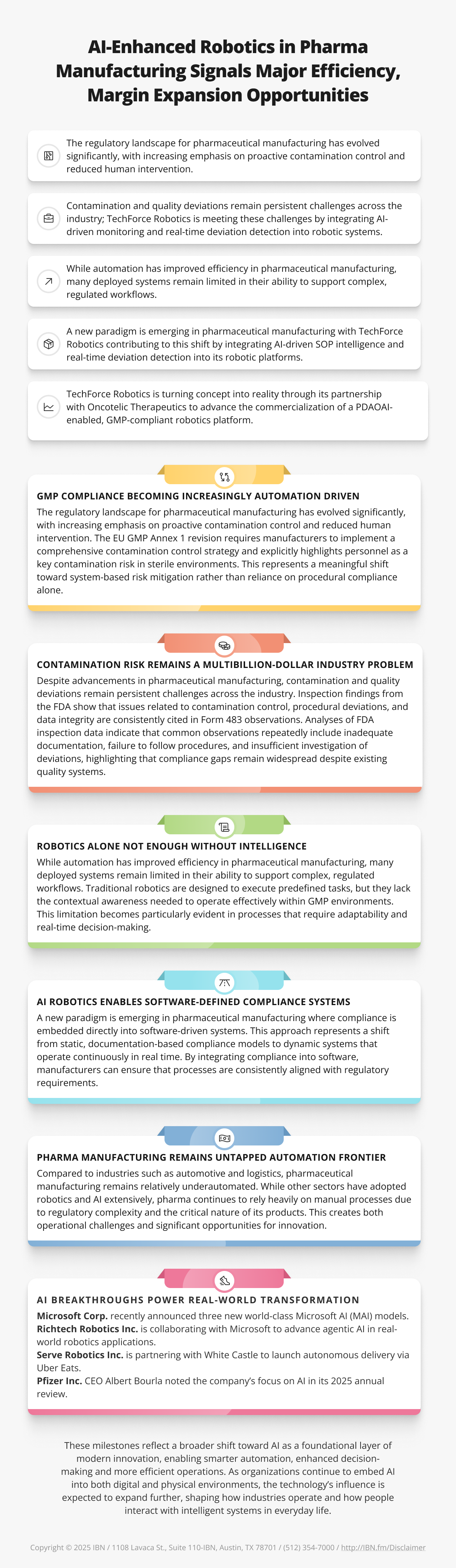
- The regulatory landscape for pharmaceutical manufacturing has evolved significantly, with increasing emphasis on proactive contamination control and reduced human intervention.
- Contamination and quality deviations remain persistent challenges across the industry; TechForce Robotics is meeting these challenges by integrating AI-driven monitoring and real-time deviation detection into robotic systems.
- While automation has improved efficiency in pharmaceutical manufacturing, many deployed systems remain limited in their ability to support complex, regulated workflows.
- A new paradigm is emerging in pharmaceutical manufacturing with TechForce Robotics contributing to this shift by integrating AI-driven SOP intelligence and real-time deviation detection into its robotic platforms.
- TechForce Robotics is turning concept into reality through its partnership with Oncotelic Therapeutics to advance the commercialization of a PDAOAI-enabled, GMP-compliant robotics platform.
GMP Compliance Becoming Increasingly Automation Driven
The regulatory landscape for pharmaceutical manufacturing has evolved significantly, with increasing emphasis on proactive contamination control and reduced human intervention. The EU GMP Annex 1 revision requires manufacturers to implement a comprehensive contamination control strategy and explicitly highlights personnel as a key contamination risk in sterile environments. This represents a meaningful shift toward system-based risk mitigation rather than reliance on procedural compliance alone.
Human operators introduce variability through movement, contact and procedural inconsistencies, even in tightly controlled cleanroom settings. Annex 1 reinforces that reducing human intervention, through isolators, restricted access barrier systems (“RABS”) and automation, is one of the most effective strategies for improving sterility assurance. This guidance reflects a growing consensus among regulators that human-dependent workflows are inherently limited in their ability to meet modern compliance expectations.
The U.S. Food and Drug Administration (“FDA”) has similarly emphasized the importance of advanced manufacturing technologies in improving consistency and reducing variability. According to FDA guidance, these technologies can enhance product quality while reducing manufacturing risks and increasing process robustness. This positions automation as a key enabler of both compliance and operational performance.
Automation also strengthens traceability and data integrity, which are central to GMP compliance. FDA guidance requires that data be attributable, contemporaneous and accurate, and automated systems are far more reliable than manual processes in meeting these standards. As manufacturers face increasing scrutiny, digital systems are becoming essential for maintaining audit-ready records and ensuring consistent documentation practices.
As these regulatory expectations continue to evolve, automation is becoming foundational rather than optional. Nightfood Holdings, through TechForce Robotics, is ideally positioned within this transition by developing AI-enabled robotic systems designed to operate within a variety of sectors, including GMP environments. By embedding compliance directly into operational workflows, the company reflects a broader shift toward intelligent, automation-driven manufacturing systems.
Contamination Risk Remains a Multibillion-Dollar Industry Problem
Despite advancements in pharmaceutical manufacturing, contamination and quality deviations remain persistent challenges across the industry. Inspection findings from the FDA show that issues related to contamination control, procedural deviations, and data integrity are consistently cited in Form 483 observations. Analyses of FDA inspection data indicate that common observations repeatedly include inadequate documentation, failure to follow procedures, and insufficient investigation of deviations, highlighting that compliance gaps remain widespread despite existing quality systems.
The consequences of these failures are significant and far-reaching. The FDA has identified manufacturing quality issues as a major contributor to drug shortages, noting that disruptions in production can directly impact supply chains and limit patient access to essential therapies. In many cases, a single contamination event can halt production for extended periods, resulting in both financial losses and regulatory consequences. Product recalls further illustrate the scale of the issue. FDA recall data shows that manufacturing defects and quality issues account for a substantial portion of recalls, underscoring the limitations of current control systems. These events not only impact revenue but can also damage brand reputation and erode trust with regulators and patients alike.
At the root of many of these challenges is the continued reliance on manual processes. Even in advanced facilities, human-dependent workflows introduce variability that can lead to deviations and compliance failures. Traditional automation has improved efficiency, but it often lacks the intelligence required to detect and respond to issues in real time.
TechForce Robotics is operating in this space by integrating AI-driven monitoring and real-time deviation detection into robotic systems. This approach enables earlier identification of risks and supports a more proactive, continuous compliance model that aligns with evolving regulatory expectations.
Robotics Alone Not Enough Without Intelligence
While automation has improved efficiency in pharmaceutical manufacturing, many deployed systems remain limited in their ability to support complex, regulated workflows. Traditional robotics are designed to execute predefined tasks, but they lack the contextual awareness needed to operate effectively within GMP environments. This limitation becomes particularly evident in processes that require adaptability and real-time decision-making.
One of the most significant gaps is the lack of SOP-level understanding. Standard operating procedures define how processes must be executed and documented, yet most robotic systems cannot interpret or adapt to these requirements. As a result, there is often a disconnect between automation systems and the regulatory frameworks they are intended to support. Additionally, traditional automation systems lack real-time decision support. They can perform repetitive tasks with high precision but cannot dynamically respond to deviations or unexpected conditions. This restricts their ability to maintain compliance in environments where variability and complexity are inherent.
Pharmaceutical manufacturing lags behind other industries in adopting advanced automation and digital technologies, highlighting a significant opportunity for transformation. This gap suggests that the next phase of innovation will require more than traditional automation. AI-enabled robotics address these limitations by integrating machine learning, analytics and contextual awareness into physical systems. These technologies enable robots to interpret data, identify patterns and make informed decisions in real time. This transforms automation from a static tool into an adaptive system capable of supporting compliance.
Nightfood Holdings is advancing this concept through its TechForce Robotics platform, which incorporates AI-driven SOP intelligence and contextual awareness. By bridging the gap between automation and compliance, the company reflects a broader shift toward intelligent manufacturing systems.
AI Robotics Enables Software-Defined Compliance Systems
A new paradigm is emerging in pharmaceutical manufacturing where compliance is embedded directly into software-driven systems. This approach represents a shift from static, documentation-based compliance models to dynamic systems that operate continuously in real time. By integrating compliance into software, manufacturers can ensure that processes are consistently aligned with regulatory requirements.
In this model, SOPs become interactive and accessible within digital systems. AI platforms can guide operators and machines through processes step-by-step, reducing reliance on manual interpretation and improving consistency. This approach enhances adherence to regulatory standards while minimizing the risk of human error. AI systems also enable real-time deviation detection, which is critical for maintaining compliance. By continuously analyzing process data, these systems can identify anomalies and trigger corrective actions before issues escalate. This aligns with regulatory priorities around real-time monitoring and advanced manufacturing.
The FDA has noted that advanced manufacturing technologies can improve product quality and enhance process reliability, supporting more efficient and robust production systems. These capabilities are central to the concept of software-defined compliance. Software-driven compliance also enhances traceability by creating comprehensive digital audit trails. Every action is recorded and time-stamped, enabling manufacturers to maintain audit readiness and respond more effectively to regulatory inspections.
TechForce Robotics is contributing to this shift by integrating AI-driven SOP intelligence and real-time deviation detection into its robotic platforms. This enables compliance to function as a continuous, embedded layer within operations rather than a separate process.
Pharma Manufacturing Remains Untapped Automation Frontier
Compared to industries such as automotive and logistics, pharmaceutical manufacturing remains relatively underautomated. While other sectors have adopted robotics and AI extensively, pharma continues to rely heavily on manual processes due to regulatory complexity and the critical nature of its products. This creates both operational challenges and significant opportunities for innovation.
Industry analysis indicates that pharmaceutical manufacturing still lags behind in digital adoption, highlighting substantial potential for transformation through advanced technologies. This gap suggests that the sector is well positioned for rapid adoption of AI-enabled systems in the coming years. The convergence of AI, robotics and biotechnology is enabling new approaches to manufacturing that improve precision, consistency and scalability. These integrated systems can support compliance while also enhancing efficiency and reducing costs.
From an investment perspective, this shift reflects a broader reallocation of capital toward technologies that enhance operational performance and regulatory alignment. Companies that can deliver integrated solutions combining robotics, AI and compliance frameworks are likely to capture significant value.
Nightfood Holdings, through TechForce Robotics, is doing exactly that. The company announced a partnership with Oncotelic Therapeutics, a clinical-stage biotechnology company focused on oncology and AI-driven solutions. The two companies have entered into a strategic partnership to advance the commercialization of a PDAOAI-enabled, GMP-compliant robotics platform.
“This milestone reflects the culmination of several years of research and development efforts, resulting in an integrated platform designed to combine Oncotelic’s proprietary PDAOAI capabilities with TechForce’s robotics hardware and manufacturing expertise,” the announcement stated. “The system under development is designed to operate within GMP-regulated environments and is intended to enable automated material handling, real-time monitoring and PDAOAI-enhanced compliance workflows across pharmaceutical manufacturing and related applications.” By integrating autonomous robotics with AI-driven compliance systems, the company represents a new category of GMP-aligned automation designed for the next generation of pharmaceutical manufacturing.
AI Breakthroughs Power Real-World Transformation
Artificial intelligence continues to evolve at a rapid pace, with recent developments highlighting its growing role across software, robotics, logistics and healthcare. From advances in multimodal models capable of processing voice, text and images to real-world deployments of autonomous systems and enterprise-wide digital transformation efforts, AI is increasingly moving beyond isolated applications into fully integrated, cross-industry solutions.
Microsoft Corp. (NASDAQ: MSFT) recently announced three new world-class Microsoft AI (“MAI”) models. Available in Foundry, the three models include MAI-Transcribe-1, MAI-Voice-1 and MAI-Image-2. MAI-Transcribe-1 delivers state-of-the-art speech-to-text transcription across the top 25 most-used languages. MAI-Voice-1 is the company’s top-tier voice-generation model, built to generate natural, realistic speech that preserves speaker identity even across long-form content. MAI-Image-2 has turbocharged image-generation performance and speed on Copilot after debuting as a top 3 model family on the Arena.ai leaderboard.
Richtech Robotics Inc. (NASDAQ: RR) is collaborating with Microsoft to advance agentic AI in real-world robotics applications. The two companies are involved in a joint engineering effort to enhance Richtech’s ADAM robot and extend intelligent automation across physical environments. The hands-on collaboration with Microsoft through the Microsoft AI Co-Innovation Labs will focus on applying vision, voice and autonomous reasoning to physical environments, enabling robots to move beyond task execution and support more contextual, conversational and operationally aware interactions.
Serve Robotics Inc. (NASDAQ: SERV) is partnering with White Castle to launch autonomous delivery via Uber Eats. According to the announcement, the two companies are collaborating to deliver White Castle’s beloved Sliders and Crave-worthy menu items via Serve’s autonomous delivery robots on Uber Eats. The partnership further expands Serve’s presence on the Uber Eats platform, which already offers Serve’s robotic deliveries in Los Angeles, Miami, Dallas–Fort Worth, Atlanta (including Buckhead), Chicago, Fort Lauderdale, and Alexandria, Virginia, with additional U.S. cities coming soon.
Pfizer Inc. (NYSE: PFE) CEO Albert Bourla noted the company’s focus on AI in its 2025 annual review. “We’ve made bold, strategic investments in digital transformation as we continually reimagine how medicines and vaccines are discovered, developed and delivered,” states Bourla in the review. “Over the past several years, our teams have moved to shape future innovation with powerful artificial intelligence (“AI”) tools. As we enter 2026, AI has become a key element in how we work, driving innovation and productivity across every facet of our business.”
These milestones reflect a broader shift toward AI as a foundational layer of modern innovation, enabling smarter automation, enhanced decision-making and more efficient operations. As organizations continue to embed AI into both digital and physical environments, the technology’s influence is expected to expand further, shaping how industries operate and how people interact with intelligent systems in everyday life.
For further information about Nightfood Holdings Inc., please visit the Nightfood Holdings profile.
About AINewsWire
AINewsWire (AINW) is a specialized communications platform with a focus on the latest advancements in artificial intelligence (“AI”), including the technologies, trends and trailblazers driving innovation forward. It is one of 75+ brands within the Dynamic Brand Portfolio @ IBN that delivers: (1) access to a vast network of wire solutions via InvestorWire to efficiently and effectively reach a myriad of target markets, demographics and diverse industries; (2) article and editorial syndication to 5,000+ outlets; (3) enhanced press release enhancement to ensure maximum impact; (4) social media distribution via IBN to millions of social media followers; and (5) a full array of tailored corporate communications solutions. With broad reach and a seasoned team of contributing journalists and writers, AINW is uniquely positioned to best serve private and public companies that want to reach a wide audience of investors, influencers, consumers, journalists, and the general public. By cutting through the overload of information in today’s market, AINW brings its clients unparalleled recognition and brand awareness.
AINW is where breaking news, insightful content and actionable information converge.
To receive SMS alerts from AINewsWire, text “AI” to 888-902-4192 (U.S. Mobile Phones Only)
For more information, please visit www.AINewsWire.com
DISCLAIMER: AINewsWire (AINW) is the source of the Article and content set forth above. References to any issuer other than the profiled issuer are intended solely to identify industry participants and do not constitute an endorsement of any issuer and do not constitute a comparison to the profiled issuer. The commentary, views and opinions expressed in this release by AINW are solely those of AINW. Readers of this Article and content agree that they cannot and will not seek to hold liable AINW for any investment decisions by their readers or subscribers. AINW is a news dissemination and financial marketing solutions provider and are NOT registered broker-dealers/analysts/investment advisers, hold no investment licenses and may NOT sell, offer to sell or offer to buy any security.
The Article and content related to the profiled company represent the personal and subjective views of the Author and are subject to change at any time without notice. The information provided in the Article and the content has been obtained from sources which the Author believes to be reliable. However, the Author has not independently verified or otherwise investigated all such information. None of the Author, AINW, or any of their respective affiliates, guarantee the accuracy or completeness of any such information. This Article and content are not, and should not be regarded as investment advice or as a recommendation regarding any particular security or course of action; readers are strongly urged to speak with their own investment advisor and review all of the profiled issuer’s filings made with the Securities and Exchange Commission before making any investment decisions and should understand the risks associated with an investment in the profiled issuer’s securities, including, but not limited to, the complete loss of your investment.
AINW HOLDS NO SHARES OF ANY COMPANY NAMED IN THIS RELEASE.
This release contains “forward-looking statements” within the meaning of Section 27A of the Securities Act of 1933, as amended, and Section 21E the Securities Exchange Act of 1934, as amended and such forward-looking statements are made pursuant to the safe harbor provisions of the Private Securities Litigation Reform Act of 1995. “Forward-looking statements” describe future expectations, plans, results, or strategies and are generally preceded by words such as “may”, “future”, “plan” or “planned”, “will” or “should”, “expected,” “anticipates”, “draft”, “eventually” or “projected”. You are cautioned that such statements are subject to a multitude of risks and uncertainties that could cause future circumstances, events, or results to differ materially from those projected in the forward-looking statements, including the risks that actual results may differ materially from those projected in the forward-looking statements as a result of various factors, and other risks identified in a company’s annual report on Form 10-K or 10-KSB and other filings made by such company with the Securities and Exchange Commission. You should consider these factors in evaluating the forward-looking statements included herein, and not place undue reliance on such statements. The forward-looking statements in this release are made as of the date hereof and AINW undertakes no obligation to update such statements.
Please see full terms of use and disclaimers on the AINewsWire website applicable to all content provided by AINW, wherever published or re-published:
https://www.AINewsWire.com/Disclaimer
AINewsWire
Austin, Texas
www.AINewsWire.com
512.354.7000 Office
Editor@AINewsWire.com
AINewsWire is powered by IBN